
|
Are you looking for professional development that will challenge you to level-up your teaching, open up new collaborative opportunities, and bring a global perspective to your classroom? If so, you should consider applying for a Fulbright Teacher Exchange. I’m currently participating in the Fulbright Teachers for Global Classrooms program, a year-long fellowship with four components: a rigorous, online global education class in the fall; a global education symposium in Washington, D.C., in the winter; a two-week field study abroad in spring or summer where you are partnered with a host teacher and get to visit schools and work with students; and the creation of global education guide to share experiences and skills gained. Application & notification The application was long and detailed, asking for evidence of leadership, essays, two references, and articulating a desire to shake up your teaching by incorporating global competencies. I submitted my application in February and settled in for a long wait. My acceptance notification came at the end of July. Being part a Fulbright Teacher Exchange has long been a "bucket list" professional goal, so I was very excited to receive this outstanding news! Next came the onboarding process: getting a physical to ensure you’re healthy enough to travel abroad, signing a lengthy terms of agreement document, and getting signed into an online platform that is the home base for communication, classwork, and collaboration. Global Teaching class The online class is rigorous and demands immediate implementation of course content. The idea is that global competencies aren’t “extra additions” to the curriculum; they should be embedded into what you’re already teaching, and they can be integrated into any subject at any grade level. The course included articles and videos, live webinars, discussion boards, reflections, and written work. Assignments included an inter-school activity, where teacher participants were paired and asked to design and carry out a collaborative project where their students communicate with each other in order to broaden their perspectives. Students in my small, rural community of 2,500 people were paired with kids attending a school on the upper west side of Manhattan in New York. In order to challenge assumptions between our urban and rural environments, we had our students draw neighborhood maps showing places they visit often, and audio record themselves explaining their maps. The maps and audio recordings were posted on a Padlet where the classes could view and comment on one another’s posts. The course was chock-full of amazing resources and teaching ideas, and I know I’ll continue to build on what I learned. I also learned from and alongside fantastic educators from all around the country. My PLN just increased exponentially. Field experience announcement After completing the online course, we were all anxiously awaiting the announcement of where we would travel for our field experience. We knew the 120 master teachers selected for this year’s TGC program would be divided into groups of 12-20 for our travel abroad experience. We were told to expect an email announcement before Christmas. My email arrived on a Friday morning and I found out I would be going to Taiwan! I have never been to Asia, so I was definitely excited about my placement. Preparing for symposium and field experience
We had a few weeks off following the holidays and then began preparing for an in-person Global Education Symposium held Feb. 5-7 in Washington, D.C. This experience will allow us to collaborate face-to-face with the people we’ve been working with virtually since last fall. I’ll meet the people I’ll be traveling to Taiwan with and we’ll prepare for our field experience.
0 Comments
I am excited to partner with the South Central Kansas Library System (SCKLS) to present a five-part webinar series called "Beyond Borders." Episodes are being released Nov. 2025-March 2026 and available to watch on demand on the SCKLS website. Two episodes have already dropped, and I hope you'll consider taking 30 minutes out of your day to watch a webinar and learn about how you can integrate new learning adventures into the library. (You must register with your email address to view the video.) Each episode includes access to slides with links to resources and recommended book lists. Ready to view: Coming soon...
I was introduced to the idea of attending SDCC as a professional development opportunity when I took part in a National Endowment for the Humanities K-12 teacher institute on Using Comics to Teach Social Justice held at San Diego State University's Center for Comic Studies in 2024. The two-week program featured lectures, comic-making workshops, activities, field trips, and collaborative lesson planning labs. The experience culminated in four days attending SDCC, an immersive experience that brings creatives and fans together through panel discussions, presentations, exhibitions, and more. You can read more about my experience here. Since 2018, San Diego Central Library has hosted the Comic-Con Convention for Educators and Librarians (CCEL). Within walking distance of the convention center where many SDCC events are held, the library events are free and open to the public. You can attend CCEL events at the library even if you don’t have a Comic-Con badge (learn more about badges below). There are comic and pop culture conventions and festivals held all over the country. You don’t have to travel to San Diego; educators and librarians can take part in engaging learning opportunities at local events. If you want to know specifically how SDCC works and how you can get special perks as an educator or librarian, I have created this guide to help you get started. 1. Getting badges SDCC takes place in late July each year. Visit the official Comic-Con website for dates and details. The website is a bit clunky to use, but they do a good job of providing step-by-step instructions. To attend SDCC events, you will need to purchase a badge (they use a badge system instead of tickets). There is a high demand for badges but a limited supply, so it can be difficult to get one. Badges are sold online twice a year. There is one date for returning attendees (if you had a badge last year) and another date for open registration for the general public. Prior badge sale day, each person a badge needs to create a free member ID on the website. The convention runs Thursday - Sunday. You may get a badge to attend a single day or any combination of the days. If you purchase a badge for all four days, you may also have the opportunity to get a badge for preview night on Wednesday, which gets you into the exhibit hall where you can be among the first to pick up free swag from vendors and purchase exclusive items. Having preview night plus Thursday - Sunday is called a “full” badge. Badge prices and details can be found on the Comic-Con badge webpage. To give you an idea of how competitive it is to get a badge, the SDCC Unofficial Blog estimates that returning attendees have a 50% chance of getting a badge while those vying for open registration have a 6% chance. 2. Professional status Comic-Con offers the option to apply for Professional status if you are a librarian or educator or if you are part of the comic and popular arts industry: actor, writer, artist, animator, filmmaker, producer, costume designer, etc. When I attended the teacher institute, one major perk was that I was awarded Professional status as an educator. This entitles me to a free Comic-Con badge for three years, which is an amazing gift! Professional status also allows me to purchase up to two “full” guest badges. This is an incredible benefit! Badges are difficult to get because attendance is capped due to space and demand is high, so many people who try to purchase badges are unable to get one. Having a guaranteed opportunity to get “full” badges is a very special benefit. To apply for Professional status, visit the Comic-Con Professional page and read and follow the instructions. Applications are due in September. If you are granted Professional status, you will still need to register for your badge in order to attend the convention. All instructions and details are on the website. 3. Sessions and panels and signings, oh my! Comic-Con features around 700 separate events held in the downtown Convention Center, nearby hotels, and the surrounding area. From the Comic-Con website: “Over the years, Comic-Con has become the focal point for the world of comics conventions. The event continues to offer the complete convention experience: a giant Exhibit Hall (topping over 460,000 square feet); a massive programming schedule (close to 700 separate events), featuring comics and all aspects of the popular arts, including hands-on workshops and educational and academic programming such as the Comic Arts Conference; anime and film screenings; games; the Will Eisner Comic Industry Awards, the “Oscars" of the comics industry; a Masquerade costume competition with prizes and trophies; an Autograph Area; an Art Show; and Portfolio Reviews, bringing together aspiring artists with major companies.” I learned there is a wide variety of programming on topics other than fantasy, science fiction, comics, anime, manga, and video games. In my two years of attending, here are some of the events attended by me, my family, and friends:
4. Other considerations
Summing up my best advice:
If you go, you will have a unique and unforgettable experience. Learning opportunities abound, and it's definitely a chance to step outside your comfort zone. Plan ahead, be flexible, and have fun!
Thanks to radio host Glen Grunwald for inviting me into the KWBW 1450 Am 98.5 Fm studio to talk about the travel-and-learn teacher programs I have lined up for this summer. I am traveling to Germany for a 10-day teacher study trip with the Atlantik Brücke organization and will also spend a week in Washington, D.C. for the White House History Teacher Institute.
The interview is available in podcast form here.
Brownlee will visit schools, cultural sites, and museums, and meet with German decision-makers from the fields of politics, media, business, and education. According to their website, “Atlantik-Brücke has offered these study trips for over 30 years and has in the process welcomed hundreds of American teachers from various regions of the United States to Germany.”
“I am excited to meet German teachers and learn about modern Germany,” Brownlee said. “Most of my knowledge of the country is from a historical perspective.” Brownlee earned a bachelor's degree from Bethany College and a master's degree from Emporia State University. In 2017, she was named Kansas School Librarian of the Year. She was a Fulbright-Hays Fellowship recipient chosen for the Ethiopia for Teachers study trip to Africa in July 2010. Last summer, Brownlee took part in a National Endowment for the Humanities teacher institute. During her 25-year career, she has secured over $94,000 in grant funding and given over 40 workshop presentations.
Thanks to AASL Smart Brief for including my article in your publication!
The institute culminated in participants attending Comic-Con International, the largest comic book and pop culture convention in the world. At the convention, I was able to attend workshops and panel discussions, meet book creators, interact with industry professionals, and collect free comics and memorabilia to share with students. Comic-Con celebrates the creative arts: writing, illustrating, performing, costuming, and more. It brings together fans and creatives and provides opportunity for interaction and mentorship. The convention also offers a variety of panels where educators share how they are harnessing students’ enthusiasm about comics to enhance learning. The best part of the institute was networking with other teachers at the institute and learning about what’s going on in their schools. One of my favorite experiences was the day all 25 of us shared a lesson we plan to take back and implement with our students. I was blown away by the amazing and creative ideas for teaching through comics and graphic novels. I was already using a graphic novel in my fifth and sixth-grade literature circle class prior to this workshop, and I look forward to extending comics lessons to more students in the coming year. I also hope to start a graphic novel book club. Interested in learning about professional development opportunities through the National Endowment for the Humanities? Take a look at their website. Applications open in mid-December for workshops taking place in the summer of 2025.
Last year I discovered the 3rd Annual Future Ready Librarians Digital App Smash where around 25 librarians from across the country contributed to a webinar where each person gave a two-minute description of a digital tool and told how they use it in the library.
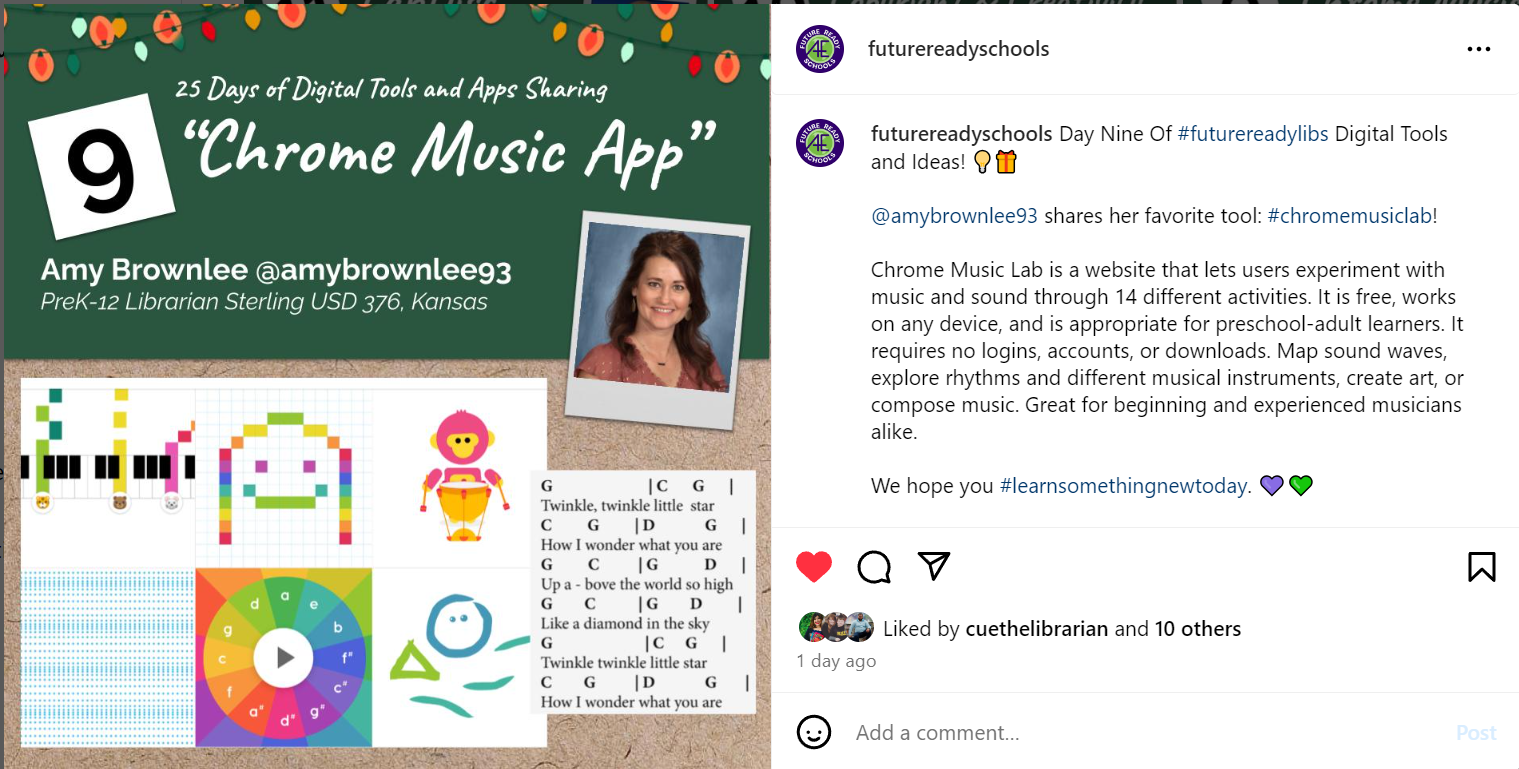
This year I had the opportunity to not only attend the webinar but also to be one of the presenters! Here is the 4th Annual Digital App Smash webpage where you can view the recorded webinar and access the slides so you can click on links and take more time to explore some of the tools. If you follow Future Ready Schools on social media, they are sharing the apps from the webinar as part of their "25 Days of Digital Tools and Apps Sharing" campaign. You can find me on Day 9 sharing information about Chrome Music Lab.musiclab.chromeexperiments.com/ I came away from the webinar with a list of tools I wanted to try and share with my teachers. I loved being able to learn about the apps and websites being used by other librarians around the country. I think this webinar is well worth your time if you want to take a look. |
Amy BrownleeLibrarian, reading teacher, presenter. Archives
February 2026
Categories
All
|


RSS Feed
